
Quick Answer
Custom production ties up $1,200 or more per style and six to eight weeks before you know what your customers buy. Small wholesale test orders let you try many styles at once, learn your real size curve, and prove your marketing works — then manufacture the styles that have already sold. Below: the real cost of manufacturing first, how to build a test order that tells you something, and the six signals that mean it is time to produce.
Almost every new boutique owner arrives at the same question within the first month: should I find a factory and make my own designs?
It feels like the serious move. A brand with its own styles sounds like a real business, while reselling someone else’s styles sounds like a placeholder. But for a store with no sales history, manufacturing first is the most expensive way to find out what your customers want.
This guide explains what custom production actually costs a new store in money and in time, what a small wholesale test order teaches you that a factory order cannot, and the specific signals that tell you when manufacturing has become the right decision.
The Short Answer
Start by buying small quantities of existing ready-stock styles. Sell them. Watch what moves and what sits. Then manufacture the styles that have already proven themselves.
This is not an argument against having your own brand. It is an argument about sequence. Manufacturing is how you scale something that works, not how you find out whether it works.
What Manufacturing Actually Costs a New Store
The money
Most clothing manufacturers set a minimum of 50 to 100 pieces per style, per colour. At Winsome Fashion our custom production minimum is 60 pieces per style per colour, which is on the low end for the industry but still a real commitment.
Run the numbers on a single style:
| Line | Amount |
|---|---|
| 60 pieces at $20 each | $1,200 |
| Sampling fee | $80–$150 |
| Committed before a single sale | $1,280–$1,350 |
That is one design, in one colour. Want the same dress in black and in red? That is two runs, 120 pieces, and roughly $2,500.
Our sampling fee is refunded once that style reaches 60 pieces in bulk production, which softens the entry cost. It does not change the core problem: you are betting over a thousand dollars on a style no customer has ever seen.
The time
The money is recoverable. The time is not.
| Stage | Typical duration |
|---|---|
| Sampling | 7–10 days |
| Sample revisions (usually one or two rounds) | 1–3 weeks |
| Bulk production, regular styles | 10–20 days |
| Bulk production, heavily embellished styles | 25–45 days |
| Shipping | Varies by destination |
Add it up honestly and a new style commonly takes six to eight weeks to reach your store, sometimes longer if the first sample is not right. Ready stock, by comparison, is dispatched 2–3 business days after payment.
The cost that actually matters: cycle count
Here is the part most beginners miss. Running a store is a loop: get stock, photograph it, list it, market it, see what happens, adjust. Everything you learn comes from completing that loop.
In a three-month season, a store that manufactures its first collection completes that loop roughly once. A store testing ready stock completes it six to eight times.
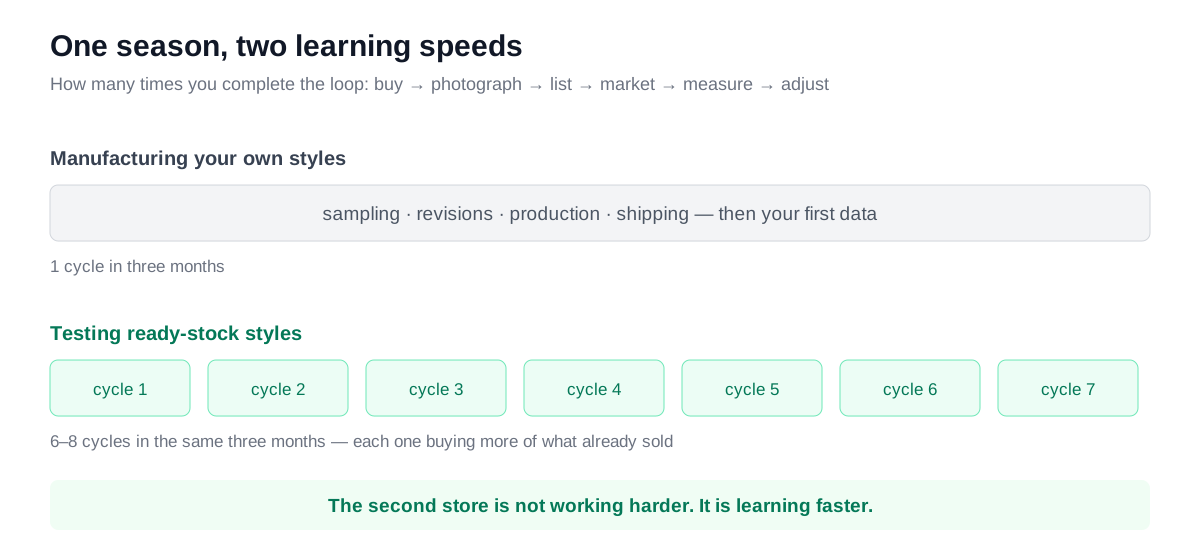
The second store is not working harder. It is simply learning faster, and by the end of the season it knows things the first store is still guessing at.
The Risk Nobody Warns Beginners About: Your Size Curve
Ask a new boutique owner what they are afraid of and they will say “picking the wrong style.” Reasonable fear. But in practice, the inventory that goes dead in a new store is usually not the wrong style — it is the wrong sizes of the right style.
When you commit to 60 pieces, you have to decide the size breakdown. Maybe you order 10 S, 20 M, 20 L, 10 XL because that distribution looks sensible. Then you open the store and discover your actual customers skew two sizes larger than you assumed. The style sells beautifully. You just bought the wrong half of it.
The same applies to colour. You believe your customers want black. Six weeks later you learn they want emerald, and you own 60 black dresses.
A new store has no way of knowing these things in advance, because the data only exists once you have customers. Small mixed orders generate exactly that data. After two or three test orders you know your size curve and your colour preferences, and a production run stops being a guess.
The Same Budget, Two Ways
Say you have about $1,300 for your first inventory.
| Manufacture one style | Test ready stock | |
|---|---|---|
| What you get | 60 pieces, one style, one colour | 40+ pieces across many different styles |
| Styles tested | 1 | 10–20 |
| Time to first sale | 6–8 weeks | Days after arrival |
| If it sells | Good — you have depth | Reorder it, dispatched in 2–3 days |
| If it does not | $1,300 of one dress | You learned cheaply and moved on |
There is a second dimension too: how often that money turns over. Manufacturing commits your capital once. Spend it and it is locked up until the stock sells. With small wholesale orders you buy, sell and reorder winners, so the same $1,300 can cycle through your business two or three times in a season — and each cycle gets smarter than the last, because you are buying more of what already sold.
At Winsome Fashion our wholesale minimum is 5 pieces per order, mixed however you like across any styles, colours and sizes, with no per-style minimum. One piece of a style is fine. Most dresses run $18–$38, which is our typical range rather than a cap — heavily embellished sequin and rhinestone styles go higher, up to around $63. Volume pricing applies to the order as a whole: 6–29 pieces take $1 off each piece, 30 or more take $2 off each piece.
What a Small Test Order Is Really Testing
Most people think they are testing styles. You are actually testing three things at once, and you need all three to work.
1. The styles. Which dresses do your customers respond to? This is the obvious one.
2. Your customers. What sizes do they buy? What colours? What price will they pay, and where do they stop? Does a $120 dress sell in your market, or does everything above $80 stall?
3. Your own marketing. This is the one people skip, and it is the one that sinks new stores. Can you photograph a dress so it looks worth the price? Does your product copy convert? Are your ads finding the right people? Is your pricing right for your market?
That third category matters because of what it implies: if a dress does not sell, the problem may not be the dress. It may be the photo, the price, the caption or the channel. Manufacturing cannot fix any of those. If your marketing is not working yet, a custom production run just means you own 60 pieces of a dress your marketing still cannot sell.
Prove your marketing works on someone else’s styles. Then put your own styles behind it.
How to Build a Test Order That Tells You Something
A test order is a diagnostic tool, so build it to produce clear results.
- Go wide, not deep. One or two pieces per style across many styles beats ten pieces of one style. You are looking for signal, not stock depth.
- Mix the risk. A useful split is roughly half safe styles you are confident about, a third that test a hypothesis about your market, and the rest as deliberate long shots. The long shots are where surprises come from.
- Buy the sizes you expect to be most common first. You are testing demand, not building a full size run. The full range comes later, once you know the curve.
- Photograph everything the day it arrives. Your test is only as good as your listings. Stock that sits unphotographed for two weeks has tested nothing.
- Watch the first two to three weeks. Track what sold, how fast, what got added to carts but not bought, and what came back and why. Pay attention to sizes most of all.
- Reorder winners immediately. This is the advantage of ready stock. A style that sells out can be reordered and dispatched in 2–3 business days. Keep reordering until a style clearly plateaus.
Your mix should reflect your store type. An online store can test the widest range because listings are cheap. A physical store needs enough pieces to fill a rail, so fewer styles with slightly more depth. A rental store should test durability and fit consistency above everything, because every piece needs to survive many wears.
When It Is Time to Manufacture
This is the part most “do not manufacture yet” advice never gets to. The answer is not never. It is when you have evidence instead of hopes.

Move to custom production for a specific style when most of these are true:
- You have reordered it three or more times. One good month is luck. Three reorders is a pattern.
- Roughly half the units sell within two weeks of arrival. Fast sell-through means demand, not just curiosity.
- Its return rate is lower than the rest of your range. Returns tell you whether the fit and the quality match the customer’s expectation.
- You know its size curve from real sales, not from an industry chart.
- You can presell. Repeat customers who will pay a deposit, or a waitlist that fills, means a production run is funded before it is made.
- You keep selling out. If you are losing sales because stock is gone, depth is now worth more to you than variety.
When you hit those markers, the 60-piece commitment stops being a bet and becomes a sensible purchase of something you already know you can sell.
The Honest Costs of Buying Small
Small wholesale orders are the right starting point, not a free lunch. Here is what you give up.
Higher unit cost. You will pay more per piece than you would producing 500 of your own. That premium is the price of flexibility, and it is usually worth it early on, but it is real.
No exclusivity. Catalogue styles are not exclusive. Other boutiques can buy the same dress, and we do not appoint exclusive distributors in any country. If exclusivity is essential to your positioning, that is an argument for custom production — once you have earned the data to do it safely. In custom orders, the design belongs to you.
Stock can sell out. Ready stock moves. A style you love may be unavailable when you want to reorder. We tell you immediately if a size is out and we never substitute a style or colour without your approval, but we cannot promise a style will still be there in two months.
Shipping hits small orders hardest. On a 5-piece parcel, express shipping can be $8–$10 per dress. On a 30-piece order it is closer to $5. The cost per piece falls as orders grow.
Landed cost is higher than the list price. This is the one that catches new importers. For a US buyer, a $28 dress lands at roughly $44–$51 per piece once shipping and roughly 36% duty are included. Price your retail from the landed number, not the wholesale number. Our landed cost worked example shows the full math at 6, 30 and 100 pieces, and we quote duty-paid wherever the destination allows it, so nothing is left to settle on delivery.
You Can Have Your Own Brand Before You Manufacture
A lot of the pressure to manufacture early comes from a false assumption: that having a brand requires producing your own designs. It does not. There is a middle step most new owners do not know about.
Step 1 — Ready stock. Buy existing styles in small quantities. Test, learn, build a customer base. Your brand lives in your curation, photography and service.
Step 2 — Ready stock with your label. We sew your own brand labels into ready-stock pieces for $1 per piece. Your customers receive a dress with your name in it. From their side it is your product, and you have committed nothing beyond the order itself.
Step 3 — Full custom production. 60 pieces per style per colour, your design, your fabric choices, your fit. By the time you reach this step you know which style to produce, in which colours, in which size breakdown, because your own sales told you.
Most boutiques that fail at step 3 failed by jumping there directly. The ones that succeed usually spent a season or two at steps 1 and 2 first.
Where to Start
If you are at the beginning, the sequence is simple: buy a small mixed order of existing styles, sell it properly, pay attention to what the data tells you, reorder what works, and manufacture only when a style has earned it.
Our minimum is 5 pieces per order, mixed across any styles, colours and sizes. There is no online payment on our site — you submit an order through the cart or send us a WhatsApp inquiry, and we confirm stock, shipping and your total before you pay anything. Orders are dispatched 2–3 business days after payment, and we confirm transit time for your destination when we quote.
For more on minimums, shipping and payment terms, see our wholesale dress FAQ. If you are still building your budget, how much it costs to start a dress boutique covers the rest of the startup math, wholesale dress profit margins covers what to expect once you are selling, and low MOQ wholesale dresses covers how small orders work in practice.
Not sure which styles fit your market? Send us your country and your target retail price, and we will tell you honestly which styles work at that price point — and which ones to skip.
Frequently Asked Questions
Start with wholesale. Manufacturing requires a commitment of 50 to 100 pieces per style per colour and six to eight weeks before the stock reaches you, all before you know what your customers buy. Small wholesale orders let you test many styles at once, learn your size curve and prove your marketing works, then manufacture the styles that have already sold.
It varies widely by supplier. Many wholesalers require packs of six per style or a minimum spend of a few hundred dollars. At Winsome Fashion the minimum is 5 pieces per order in total, mixed across any styles, colours and sizes, with no per-style minimum, so you can order a single piece of a style to test it.
Most manufacturers require 50 to 100 pieces per style, per colour. Our custom production minimum is 60 pieces per style per colour, with a sampling fee of $80 to $150 that is refunded once that style reaches 60 pieces in bulk. Sampling takes 7 to 10 days and bulk production 10 to 20 days for regular styles, or 25 to 45 days for heavily embellished ones.
Yes. We sew your own brand labels into ready-stock pieces for $1 per piece, so you can sell under your own name without custom production. This is the step between plain wholesale and a full manufactured collection, and most new boutiques should spend time here before committing to a production run.
When a specific style has proven itself: you have reordered it three or more times, about half the units sell within two weeks of arrival, its return rate is below the rest of your range, and you know its real size and colour demand from your own sales. If you can presell to repeat customers or you are regularly selling out, depth is worth more to you than variety, and a production run becomes a sound purchase rather than a gamble.