
Quick Answer
There are three common ways to source dresses from China. Factory direct gives the lowest unit price but limits you to what that one factory makes, and you manage QC and logistics yourself. A trading company offers wide selection and handles logistics, but marks up prices and rarely discloses the factory price. A sourcing agent charges a commission (typically 5–10%) to find and manage factories on your behalf, which pays off once orders are large or highly customised. For most small boutiques ordering under roughly $5,000 a month, an agent’s commission outweighs the benefit — factory direct or a factory-backed partner usually wins. The deciding factors are your order size, how much variety you need, and whether you have the time to manage suppliers yourself.
Introduction: The Question Every Dress Buyer Eventually Asks
If you have been sourcing wholesale dresses from China, you have probably wondered whether you need a China dress sourcing agent — and if so, how to choose one.
The internet is full of advice on this topic — and most of it is written by sourcing agents trying to sell you their services. So let’s skip the sales pitch and have an honest conversation.
This guide will explain what each model actually is, what it costs, when it works, and when it doesn’t — specifically for the dress and fashion apparel category, where the rules are different from sourcing electronics or home goods. By the end, you should know exactly which sourcing model fits your boutique, your order size, and your risk tolerance.
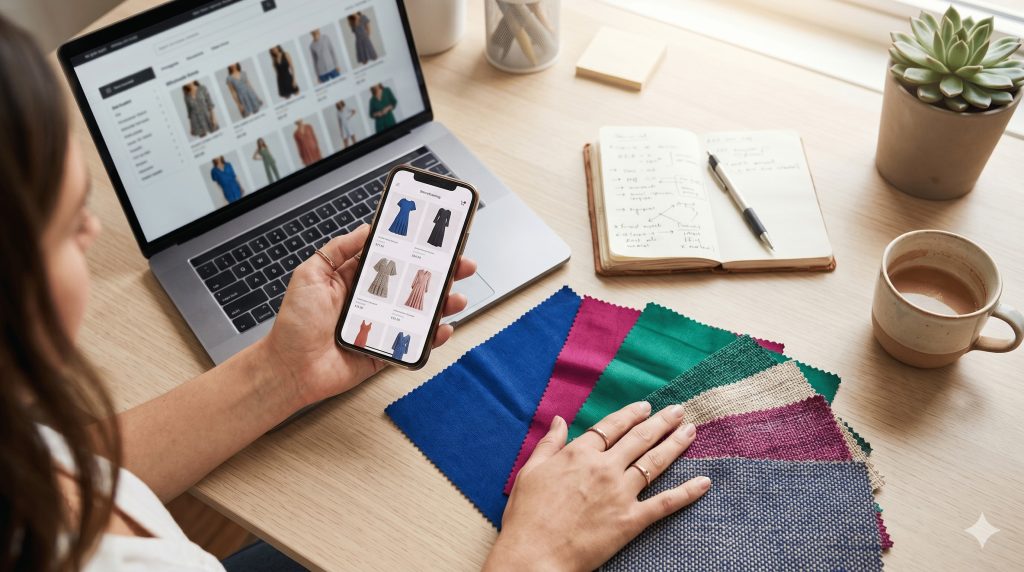
China Dress Sourcing Agent vs Factory vs Trading Company
Before we compare, let’s define each model clearly. The terminology is used loosely in the industry, so precision matters.
Model 1: Factory Direct
You contact a dress manufacturer directly, negotiate price, place your order, and the factory ships to you. No intermediary.
How it works in the dress world: You find a factory on Alibaba, at a trade show, or through a referral. You communicate directly with their sales team (usually via WhatsApp or WeChat). You request samples, approve them, place an order, and the factory handles production and shipping.
Who it’s best for: Buyers ordering 300+ pieces per style who know exactly what they want, can communicate clearly with Chinese factories, and have the experience to manage quality control remotely.
Who it’s worst for: First-time buyers, small boutiques needing variety across many styles, and anyone who doesn’t have time to manage the factory relationship hands-on.
Model 2: Trading Company
A Chinese company that buys finished dresses from multiple factories and resells them to international buyers at a markup. They hold inventory or place orders on your behalf, but they are the seller — you buy from them, not from the factory.
How it works in the dress world: You browse their catalog (website, WeChat album, or showroom), pick styles, and order. The trading company handles everything — sourcing, packing, shipping. You never interact with the factory.
Who it’s best for: Buyers who want a hands-off experience, need ready-made styles with no customization, and prefer ordering from a single catalog rather than managing multiple factory relationships.
Who it’s worst for: Buyers who need price transparency (the markup is hidden in the unit price), custom OEM work, or direct control over production quality.
Model 3: Sourcing Agent (or Sourcing Partner)
A person or company based in China who works on your behalf to find factories, negotiate prices, inspect quality, and manage logistics. They charge a commission (typically 3-10%) or a service fee — but you pay the factory directly. The agent is your representative, not your supplier.
How it works in the dress world: You tell the agent what you need — styles, price range, quantity, quality standards. The agent searches their factory network, gets quotes, sends you options. Once you approve, the agent manages the order: monitors production, inspects before shipping, coordinates logistics.
Who it’s best for: Small to mid-sized boutiques who need variety from multiple factories but don’t have time (or Chinese language skills) to manage each relationship individually.
Who it’s worst for: Buyers with very small orders (under $500 total) where the agent’s minimum fee exceeds the value of the service, or buyers who already have established, trusted factory relationships.

Side-by-Side Comparison: The Honest Numbers
| Factor | Factory Direct | Trading Company | Sourcing Agent |
|---|---|---|---|
| Unit price | Lowest (factory price) | Highest (factory + markup) | Middle (factory + 3-10% fee) |
| Price transparency | Full — you see factory cost | None — markup is hidden | Full — agent fee is separate |
| MOQ | Usually 100-500 per style | Often 30-100 per style | Negotiable — agents can combine orders |
| Style variety | Limited to one factory’s catalog | Medium (their curated selection) | Wide — access to multiple factories |
| Quality control | You manage it yourself | Company handles it (their standards) | Agent inspects on your behalf (your standards) |
| Communication | Direct with factory (often Chinese) | With trading company (usually English) | With agent (bilingual) |
| OEM/custom ability | High (if factory is capable) | Low to none | High (agent finds the right factory) |
| Shipping logistics | You manage or factory arranges | Company handles | Agent coordinates |
| Risk if problems arise | You negotiate with factory directly | Trading company may or may not help | Agent advocates for you at factory |
| Best order size | $5,000+ per order | $500-$5,000 | $1,000-$20,000+ |
The Hidden Costs Nobody Talks About
The comparison table above shows the obvious costs. But in the dress sourcing world, the hidden costs often matter more than the unit price.
Hidden cost of factory direct:
Communication failures. Dress specifications are nuanced — fabric weight, stretch recovery, color matching, fit across sizes. A single miscommunication about fabric composition can result in 500 dresses you cannot sell. According to a detailed comparison by Sourcing Nova, buyers who go direct need strong product knowledge and the ability to communicate technical requirements clearly, because there is no intermediary to catch specification errors before production begins.
Quality variance. Without someone physically present at the factory to inspect, you are trusting the factory’s self-reported quality. In the bandage dress category specifically, the difference between a correctly tensioned rayon-nylon-spandex knit and a loose, poorly knitted substitute is invisible in photos but immediately obvious when the dress is worn. Factories rarely self-report this kind of issue.
Time cost. Managing a factory relationship takes 3-5 hours per week of your time — WeChat messages, photo approvals, size chart confirmations, shipping coordination. For a boutique owner who should be spending that time on marketing and sales, this is an expensive trade-off.
Hidden cost of trading companies:
The mystery markup. Trading companies typically add 15-30% to the factory price. On a $20 wholesale dress, that means you are paying $23-$26 for a product that the trading company bought for $20. Over a year of orders, this adds up to thousands of dollars in invisible margin that goes to the middleman rather than to you or to better quality.
No factory loyalty. Because you never meet the factory, you never build a relationship. If the trading company switches factories (which they do regularly to optimize their own margins), your quality may change without warning or explanation.
Hidden cost of sourcing agents:
The commission floor. Most professional sourcing agents have minimum fees ($200-$500 per order). If your order is small, the agent’s fee as a percentage of your total spend can be higher than a trading company’s markup. For orders under $1,000, the math often doesn’t work.
Agent quality varies wildly. The barrier to entry for calling yourself a “sourcing agent” is essentially zero. Anyone with a WeChat account and basic English can claim to be one. A bad agent wastes your time, misrepresents factory capabilities, and disappears when problems arise. Vetting your agent is as important as vetting your factory.
When Each Model Makes Sense for Dress Buyers
Go factory direct when:
- You order 300+ pieces of the same style consistently
- You know exactly what fabrics, fits, and constructions you want
- You (or someone on your team) speak Chinese or the factory has a reliable English-speaking contact
- You have visited the factory at least once, or plan to
- You are doing OEM/ODM with your own designs and need deep production control
- Your total order value per shipment is $5,000+
Use a trading company when:
- You are placing a test order under $500 and want the simplest possible experience
- You need ready-made, in-stock styles with no customization
- Speed matters more than price — you need dresses shipped this week, not produced next month
- You are brand new to importing and want to learn the process with training wheels before committing to a deeper relationship
Use a sourcing agent when:
- You need variety across multiple styles and categories but don’t want to manage 5 separate factory relationships
- Your order is $1,000-$20,000 — big enough to justify the fee, small enough that factories won’t give you priority attention on their own
- You need someone to physically inspect your dresses before they ship
- You want price transparency (see the factory cost and the agent’s fee separately)
- You are sourcing bandage dresses or other construction-sensitive categories where quality control requires expertise
- You want to visit factories and need someone to arrange and translate
The Fourth Model: Factory-Backed Sourcing Partner
There is a fourth option that does not fit neatly into any of the three categories above — and for dress buyers specifically, it may be the most relevant.
A factory-backed sourcing partner is exactly what it sounds like: a company that has its own production facility for core categories (providing the quality control and pricing advantages of factory direct) while also maintaining a curated network of partner factories for additional categories (providing the variety and flexibility of a sourcing agent).
This hybrid model solves the biggest weakness of each pure model:
- Unlike pure factory direct: You are not limited to one factory’s catalog. If you need bandage dresses, sequin dresses, cotton casual wear, and jumpsuits, a single-factory relationship cannot serve all of those well. A factory-backed sourcing partner can pull from multiple specialized factories while maintaining consistent quality standards across all of them.
- Unlike a pure trading company: The pricing is transparent. You know what the factory charges and what the partner’s service costs. There is no hidden 25% markup.
- Unlike a pure sourcing agent: The partner has “skin in the game” through their own production facility. They are not just a broker collecting commissions — they have a reputation tied to the quality of the dresses they produce. This alignment of incentives matters when problems arise.
Who this model is best for: Boutique owners who want a single point of contact for their entire dress assortment — core styles from a dedicated production line, trend-driven styles sourced from the broader Guangzhou market, and everything inspected to the same standard before shipping. This is also the model that most easily supports mixed-style, low-MOQ ordering (like 6 pieces across multiple styles), because the partner can combine items from their own production and their factory network into a single consolidated shipment.
How to Vet Any China Dress Sourcing Partner (7 Non-Negotiable Questions)
Regardless of which model you choose, these seven questions will separate serious partners from time-wasters. Ask every one of them before placing your first real order.
1. “Can I visit your facility?”
A legitimate factory or sourcing partner will say yes without hesitation. Hesitation, excuses, or “we can send you a video instead” are red flags. You don’t have to actually visit immediately — but their willingness to invite you tells you everything about their confidence in what they do.
2. “What happens when a size is out of stock?”
This is the single best question for evaluating honesty. The right answer is: “We tell you immediately and offer alternatives.” The wrong answer — which is far more common than you’d expect — is silence followed by your order arriving with substituted sizes. As noted in a detailed analysis by Focus Cabinet, a direct factory approach offers maximum customization and lowest price, but requires more management — and honest stock communication is one of the areas where management matters most.
3. “What is your quality inspection process?”
Listen for specifics. “We check everything” means nothing. “We inspect stitching, fabric weight, size accuracy, and label placement on every piece, then do a second pass before packing” means something. Ask how many QC steps there are, who performs them, and what happens when a piece fails.
4. “Can you show me the factory price and your fee separately?”
If they can, you are probably dealing with a sourcing agent or factory-backed partner (good transparency). If they cannot or will not, you are probably dealing with a trading company (hidden markup). Neither is inherently wrong — but you should know which one you are paying for.
5. “What is your actual MOQ — per style and total?”
“Low MOQ” is the most overused phrase in Chinese wholesale. Get the specific number. Per style? Total across all styles? Is there a minimum dollar amount? A supplier who says “6 pieces total, mixed across any styles” is making a very different offer from one who says “50 pieces per style, minimum 3 styles.”
6. “Who pays for shipping? How long does it take?”
Get the full logistics picture upfront. Express (DHL/FedEx/UPS) usually takes 5-8 days but costs more. Sea freight is cheaper but takes 25-40 days. Some suppliers include shipping in their quote; others add it separately. Know what you are comparing.
7. “Can you send me references from current buyers in my market?”
A partner with happy clients will share references (with the client’s permission). A partner who cannot provide any references — or who deflects with “we don’t share client information” — is either new or has something to hide.
Real-World Decision Framework: Which Model Fits YOUR Boutique?
To make this actionable, here are four common boutique scenarios and the model I would recommend for each:
Scenario 1: New boutique, first order, budget under $1,000
Recommendation: Trading company or factory-backed sourcing partner with low MOQ.
Your first order is about learning, not optimizing. You need a low-risk way to test styles, understand sizing, and figure out what your customers actually want. A trading company’s ready-made catalog or a sourcing partner offering 6-piece mixed MOQ lets you experiment without overcommitting.
Scenario 2: Growing boutique, ordering $2,000-$5,000 per month, needs variety
Recommendation: Sourcing agent or factory-backed sourcing partner.
At this order volume, you need access to multiple styles across categories, but you probably don’t have time to manage 5 separate factory relationships. A sourcing partner who can pull bandage dresses from their own production and trend-driven styles from partner factories — all consolidated into one shipment with consistent QC — is the most time-efficient option.
Scenario 3: Established boutique, ordering $10,000+ per month, knows exactly what sells
Recommendation: Factory direct for core styles, supplemented by sourcing agent for new styles.
At this scale, you should have direct relationships with 1-2 factories for your bestselling categories. The per-unit savings of going direct are significant at volume. Use a sourcing agent or partner to scout and test new styles without disrupting your core supply chain.
Scenario 4: OEM brand, custom designs, needs production management
Recommendation: Factory direct (for production) with sourcing agent oversight (for QC).
If you are designing your own dresses and need custom production, you need a direct factory relationship. But unless you are physically in Guangzhou, having a sourcing agent or partner who can visit the factory, check production progress, and inspect finished goods on your behalf is worth every penny of their fee.
A Note About Winsome Fashion’s Model
In the interest of transparency — since this article is published on our website — let me explain where Winsome Fashion fits in this landscape.
We operate as a factory-backed sourcing partner. Our Guangzhou-based production facility specializes in bandage dresses and structured fashion dresses — the categories where fabric quality and construction precision matter most. For other dress categories (sequin, cotton casual, satin evening, jersey basics), we source from a network of partner factories we have vetted and worked with over 11 years.
Every order — whether from our own production or our partner factories — goes through the same double quality inspection before shipping. Our minimum order is 6 pieces mixed across any styles. We are not the cheapest option on the market, and we are not trying to be. Our value proposition is that you get one contact, consistent quality, factory-level pricing on our core categories, and access to the broader Guangzhou market without having to manage the complexity yourself.
If that matches what you need, we’d be glad to work with you. If it doesn’t — if you need pure factory-direct pricing at 500+ MOQ, or a no-commitment trading company for a tiny test order — then one of the other models described in this article is a better fit, and we’d rather you choose the right one than the one we happen to sell.
That’s the honest version.
The 2026 Sourcing Landscape: What Has Changed
Two developments in 2025-2026 have shifted the sourcing equation for U.S. dress buyers:
1. The end of de minimis ($800 exemption)
Since August 29, 2025, U.S. buyers can no longer import small shipments duty-free. This change disproportionately affects buyers who were using trading companies or drop-shipping models that relied on small-parcel imports to avoid duties. The winners in the new environment are buyers who consolidate orders into larger shipments — which favors the sourcing agent and factory-backed partner models, since both are set up to manage consolidated logistics.
2. Tariff uncertainty
With tariff rates fluctuating and new trade policies being announced regularly, having a sourcing partner who understands HS codes, duty calculations, and commercial invoicing is more valuable than ever. A factory’s sales rep is optimized for production, not trade compliance. A trading company may or may not help with customs documentation. A professional sourcing agent or partner should be able to provide correct commercial invoices, packing lists, and HS code guidance as standard practice.
Frequently Asked Questions
Q1: How much does a China dress sourcing agent typically charge?Most professional sourcing agents charge 3-10% commission on the order value, with smaller orders at the higher end of that range and larger orders at the lower end. Some agents charge a flat fee per project ($200-$500 minimum). The fee is separate from the factory price, so you have full visibility into what you’re paying for goods versus services. For orders under $1,000, the agent’s minimum fee may make this model less cost-effective than a trading company.
Q2: What is the difference between a sourcing agent and a trading company?A sourcing agent works for you — they find factories, negotiate on your behalf, and you pay the factory directly. Their fee is transparent and separate. A trading company works for themselves — they buy from factories and resell to you at a markup. You never see the factory price. The practical difference is transparency and control: with an agent, you know what you’re paying for; with a trading company, the markup is hidden in the unit price.
Q3: Can I use a sourcing agent for small orders of less than 100 pieces?Yes, but the economics matter. Most agents have minimum fees ($200-$500), so on a 50-piece order worth $800, the agent’s fee could be 25-60% of your total spend — which may exceed a trading company’s hidden markup. For very small orders, look for sourcing partners who offer low mixed-MOQ programs (like 6-piece minimums across multiple styles) rather than traditional per-style MOQs, as this structure is designed specifically for small-quantity buyers.
Q4: How do I know if my “factory” on Alibaba is actually a trading company?Several tells: (1) they offer products across wildly different categories (real factories specialize); (2) they can’t show you production photos of your specific product being made; (3) they resist factory visits; (4) delivery times are unusually long for “in-stock” items (they’re sourcing from elsewhere after you order). Ask directly: “Are you the manufacturer, or do you source from other factories?” Reputable trading companies will be honest about their model.
Q5: Should I use a sourcing agent if I already have a factory relationship?Not necessarily for that factory — but possibly for expanding your product range. Many boutique owners have a reliable factory for one category (e.g., bandage dresses) but struggle when they need to add new categories (e.g., sequin dresses, casual wear). A sourcing agent or factory-backed partner can handle the new categories while you maintain your existing factory relationship for your core product.
Q6: What is a “factory-backed sourcing partner” and how is it different from a regular sourcing agent?A factory-backed sourcing partner has their own production facility for specific product categories, combined with a network of vetted partner factories for additional categories. Unlike a pure sourcing agent (who has no production capability), this model offers factory-level pricing and quality control on core products, plus the variety and flexibility of multi-factory sourcing for everything else. The key advantage is alignment of incentives: because they produce some of the products themselves, their reputation is directly tied to quality — not just to collecting a commission.
Final Verdict: It’s Not About the Model, It’s About the Fit
The “best” sourcing model does not exist in the abstract. It depends entirely on your order volume, your product needs, your time availability, and your risk tolerance.
- Factory direct wins on per-unit cost — but only if you have the volume, expertise, and bandwidth to manage the relationship yourself.
- Trading companies win on convenience — but you pay for that convenience in hidden markups and limited transparency.
- Sourcing agents win on flexibility and quality control — but the economics only work above a certain order threshold.
- Factory-backed sourcing partners win on the combination of quality, variety, and simplicity — but they are harder to find because the model requires both production capability and sourcing expertise.
Whatever you choose, the single most important factor is not the model — it is the specific partner within that model. A great trading company will outperform a bad sourcing agent every time. A trustworthy factory-backed partner will outperform an unreliable factory every time.
Vet the partner. Ask the seven questions. Start with a small test order. Scale what works.
For deeper dives into the sourcing landscape, our earlier guides cover specific aspects of this decision:
- Where to Buy Wholesale Dresses: China vs Turkey vs India — which country to source from
- Best Wholesale Bandage Dress Suppliers in 2026 — comparing 8 specific Chinese suppliers
- Low MOQ Wholesale Dresses — how mixed-MOQ ordering works
Your sourcing model is a strategic choice. Make it deliberately, not by default.