
Quick Answer
A bodycon dress is any dress cut from stretch knit fabric that follows the body’s shape — jersey, spandex blends, cotton-lycra. A bandage dress is built from multiple strips of heavy compression knit, layered and sewn to actively sculpt the body like shapewear. Bodycon wholesales at $6–$18 and retails $25–$65; bandage wholesales at $18–$35 and retails $60–$150. Bandage has lower return rates (3–7% vs 8–15%) because compression fit accommodates more body types per size.
If you run a dress boutique — online or in-store — you have almost certainly been asked some version of this question by a customer: “Is this a bandage dress or a bodycon?” And if you are being honest, you may not have had a clear answer.
You are not alone. The terms “bandage dress” and “bodycon dress” are used interchangeably across thousands of product listings, wholesale catalogs, and Instagram posts. But they are not the same garment. The difference is structural, and for a boutique buyer making wholesale purchasing decisions, that structural difference translates directly into pricing power, return rates, customer satisfaction, and profit margins.
This guide breaks down what each dress actually is, how they differ in construction and cost, which one sells better in 2026, and — most importantly — which one your specific boutique should be stocking.
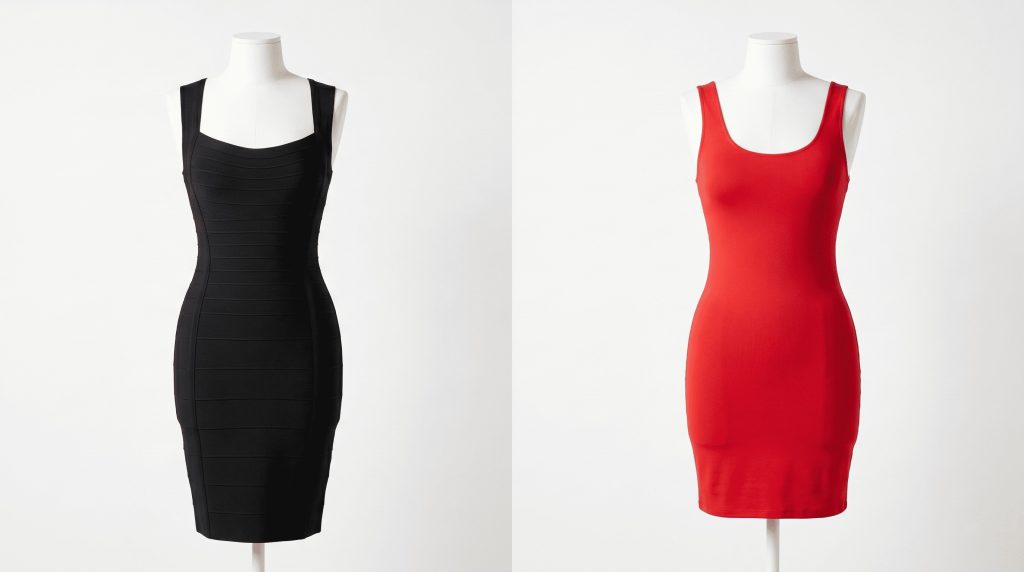
What Is a Bodycon Dress?
“Bodycon” is short for “body-conscious.” It is a category, not a specific construction method. Any dress made from stretchy fabric that is cut to follow the contours of the body falls under the bodycon umbrella.
Construction: A bodycon dress is typically cut from a single piece of stretch knit fabric — jersey, spandex-blend, or cotton-lycra — and sewn together like a conventional garment. There are no strips, no bands, no layered panels. It is a regular dress that happens to be tight.
Fabric: Lightweight stretch knits. The most common compositions are polyester-spandex blends (typically 95/5 or 92/8), cotton-lycra blends, and jersey. The fabric is thin, breathable, and gives easily when pulled.
Fit experience: A bodycon dress traces your silhouette. It shows the body’s shape but does not reshape it. If you have curves, it follows them. If you have areas you are self-conscious about, it follows those too. A bodycon dress provides no compression, no support, and no sculpting — it is a mirror, not a corset.
Price range (wholesale): $6–$18 per piece. The fabric cost is low, the construction is simple, and the market is saturated. This is a high-volume, low-margin category.
Price range (retail): $25–$65 at most boutiques.
What Is a Bandage Dress?
A bandage dress is a specific type of bodycon dress — but calling it “just a bodycon” is like calling a Porsche “just a car.” The construction is fundamentally different, and that difference is the entire point.
The bandage dress was pioneered by French designer Hervé Léger in the early 1990s. According to WWD’s comprehensive history, Léger’s viscose “bandage” dresses were formed from dozens of elasticated strips of knitted cloth, creating a body-sculpting, skin-tight silhouette that became an instant sensation. As noted in the Wikipedia entry on the bandage dress, the garments are knitted rather than woven — a critical distinction that gives them their unique structural properties.
Construction: A bandage dress is built from multiple horizontal or diagonal strips (bands) of heavy, structured knit fabric, layered and sewn together. This strip-construction creates a compression effect similar to shapewear. The dress does not just follow the body — it actively shapes it, pulling in at the waist, smoothing the hips, and supporting the bust.
Fabric: Heavyweight bandage knit, typically a blend of rayon, nylon, and spandex (commonly 90/9/1 or similar ratios). The fabric is thick, substantial, and has controlled stretch — it gives where it needs to and holds firm everywhere else. This is not a fabric you can buy at a local fabric market and sew at home; bandage knit requires specialized knitting machines.
Fit experience: Putting on a bandage dress feels closer to putting on compression sportswear than putting on a regular dress. It sculpts, it smooths, it holds. Most women who try on a well-made bandage dress for the first time report that it makes them look and feel “smaller in all the right places.” This is not an exaggeration — it is the engineering of the fabric at work.
Price range (wholesale): $18–$35 per piece for quality construction. Below $15 wholesale, you are almost certainly getting a “bandage-style” bodycon (printed strips on regular knit fabric) rather than a true bandage dress.
Price range (retail): $60–$150 at most boutiques; $200+ for premium brands.

The Key Differences: Side-by-Side
| Feature | Bodycon Dress | Bandage Dress |
|---|---|---|
| Construction | Single-piece stretch knit | Multiple strips/bands sewn together |
| Fabric weight | Lightweight (thin, breathable) | Heavyweight (thick, structured) |
| Typical composition | Polyester-spandex or jersey | Rayon-nylon-spandex bandage knit |
| Body effect | Traces the body (shows shape) | Sculpts the body (reshapes it) |
| Compression | None | Moderate to high |
| Support | No built-in support | Built-in compression support |
| Wholesale price | $6–$18 | $18–$35 |
| Retail price | $25–$65 | $60–$150 |
| Typical markup | 3–4× | 3–5× |
| Return risk | Higher (fit disappointment) | Lower (compression forgives sizing) |
| Shelf life | Trend-dependent (short) | Longer (classic silhouette) |
| Production complexity | Low | High (specialized knitting + strip assembly) |
The simplest way to tell them apart: Pull the fabric sideways. If it stretches easily and feels thin, it is bodycon. If it resists, feels heavy, and snaps back firmly when released, it is bandage.
Which Sells Better in 2026?
The honest answer: both sell, but they sell differently, to different customers, at different margins.
Bodycon: Volume winner
Bodycon dresses dominate in sheer unit volume. The global bodycon dress market was valued at approximately $3.2 billion in 2024, with a projected compound annual growth rate of 7.5% through 2033. Every fast-fashion retailer on earth stocks bodycon dresses. Amazon alone moves thousands of units per month in this category, with search volumes peaking in late summer and early autumn.
But volume is not profit. The bodycon market is brutally competitive — your $12 wholesale bodycon dress is competing with Shein’s $8 version, Amazon’s private labels, and every other wholesale buyer who sources from the same Guangzhou factories you do. Differentiation is nearly impossible. Price becomes the only competitive lever, and that is a race to the bottom.
Bandage: Margin winner
Bandage dresses sell fewer units but at dramatically higher margins. A boutique buying a bandage dress at $22 wholesale and selling it at $89 retail is earning $67 gross profit per unit — roughly the same dollar amount as selling three bodycon dresses at $12 wholesale and $35 retail ($69 total profit, but requiring 3× the inventory, 3× the shipping, and 3× the return risk).
The bandage dress also has a critical advantage in 2025-2026: it is experiencing a genuine cultural resurgence. The Gen Z revival of Y2K fashion has driven searches for “bandage dress” up significantly, and the style is riding a wave of TikTok and Instagram visibility that has introduced it to an entirely new generation of buyers. Designer Hervé Léger has capitalized on this momentum by modernizing its signature silhouette for its resort and fall collections.
The data-driven takeaway
If your boutique competes on price and volume → stock bodycon. If your boutique competes on quality, experience, and margin → stock bandage. If you are smart → stock both, but weight your inventory toward bandage.
Profit Margin Comparison: Real Numbers
Let’s put actual numbers on this, because “higher margins” means nothing without math.
Scenario A: Bodycon-heavy boutique
- Buy 100 bodycon dresses at $12 average wholesale = $1,200 investment
- Sell at $38 average retail
- Sell-through rate: 70% (30% either discounted or returned)
- Revenue: 70 × $38 = $2,660
- Discounted units: 20 × $20 = $400
- Returns/dead stock: 10 units = $0
- Total revenue: $3,060
- Gross profit: $1,860
- Margin: 60.8%
Scenario B: Bandage-heavy boutique
- Buy 60 bandage dresses at $25 average wholesale = $1,500 investment
- Sell at $89 average retail
- Sell-through rate: 80% (bandage dresses have lower return rates because compression fits forgive sizing variance)
- Revenue: 48 × $89 = $4,272
- Discounted units: 8 × $55 = $440
- Returns/dead stock: 4 units = $0
- Total revenue: $4,712
- Gross profit: $3,212
- Margin: 68.2%
Scenario B generates 73% more gross profit on only 25% more investment, with 40% fewer units to store, photograph, list, ship, and handle returns for.
This is why experienced boutique owners tend to migrate toward bandage over time. The per-unit economics are simply better.
Which Should YOU Stock? By Boutique Type
If you run an online-only boutique (Shopify, Etsy, Instagram shop):
Stock ratio: 60% bandage, 40% bodycon.
Online boutiques live and die by two things: photography and return rates. Bandage dresses photograph better (the structured silhouette looks polished in flat-lays and on mannequins) and have lower return rates (compression construction means a size S fits a wider range of bodies than a bodycon S). Your bodycon inventory should focus on trend-driven pieces — sequin, mesh overlay, cutout — that drive impulse purchases and social media shares.
If you run a brick-and-mortar boutique:
Stock ratio: 70% bandage, 30% bodycon.
In-store, the bandage dress sells itself the moment a customer tries it on. The “wow” moment — when a customer puts on a well-made bandage dress and sees the compression effect in the mirror — is the single most powerful selling tool in dress retail. You cannot replicate this online. Use it. Keep bodycon dresses as your entry-level price point to get customers in the door, then upsell to bandage.
If you serve a party/nightlife market:
Stock ratio: 50/50.
Club and party customers want both: the trendy, colorful, Instagram-ready bodycon for casual nights out ($30–$40 retail sweet spot) and the statement bandage dress for special occasions ($80–$120 retail). Stock both, merchandise them together, and train your staff (or your product descriptions) to explain the difference.
If you target a luxury or occasion-wear market:
Stock ratio: 80% bandage, 20% bodycon (or 100% bandage).
At higher price points, bodycon dresses have no place. A customer paying $100+ expects construction, not just stretch fabric. Focus entirely on quality bandage dresses and differentiate through color, neckline variety, and exclusive styles.
How to Spot Real Bandage Construction (and Why It Matters for Sourcing)
Here is the uncomfortable truth: a huge percentage of dresses sold as “bandage dresses” online are not bandage dresses at all. They are regular bodycon dresses with printed or stitched-on horizontal lines that mimic the bandage look. The wholesale price is a dead giveaway — a genuine bandage dress cannot be manufactured for under $15, because the fabric alone costs more than a finished bodycon dress.
When sourcing bandage dresses from any supplier, check these five things:
- Fabric weight. Pick up the dress. Does it feel heavy and substantial, or light and thin? Real bandage fabric is noticeably heavier than bodycon fabric.
- Strip construction. Turn the dress inside out. Are there actual individual strips of fabric layered and sewn together, or is it a single piece of fabric with surface stitching? Real bandage = real strips.
- Stretch test. Pull the fabric sideways at the waist. Real bandage knit resists — it stretches a little and snaps back firmly. Bodycon fabric gives easily and keeps stretching.
- Zipper. Most authentic bandage dresses have a back zipper because the compression fabric has limited give — you cannot just pull it on over your head. If a “bandage dress” has no zipper and pulls on easily, it is bodycon.
- Price. If the wholesale price is under $15, it is almost certainly not genuine bandage construction. The fabric cost alone makes sub-$15 bandage dresses economically impossible.
This is one area where your choice of supplier matters enormously. A factory or sourcing partner that specializes in bandage dresses will use the right knitting machines, the right rayon-nylon-spandex blend ratios, and the right strip-assembly techniques. A general-purpose garment factory will often substitute cheaper fabrics and skip the strip construction entirely while still calling the product a “bandage dress.”
At Winsome Fashion, bandage dresses are our production specialty — it is the category where our Guangzhou-based production facility has invested most heavily over the past decade, from specialized knitting equipment to pattern development. This is also why we inspect every bandage dress order twice before shipping: the margin for error in bandage construction is smaller than in any other dress category, and a poorly made bandage dress is worse than useless — it will generate returns and damage your store’s reputation.
Merchandising Tips: How to Sell More of Both
Whether you stock bandage, bodycon, or both, how you present them determines how they sell.
For online stores:
Product photography matters more for bandage dresses. Invest in mannequin shots (not just flat-lays) that show the sculpting effect. If possible, include a short video clip showing the fabric’s weight and stretch — this is the most effective way to communicate the bandage difference online. In your product description, always specify the fabric composition and construction method. “Bandage construction, rayon-nylon-spandex blend” signals quality to informed buyers. “Bodycon fit, polyester-spandex blend” signals that it’s a different (and cheaper) product. Never mislead.
For bodycon dresses, variety is your weapon. Since bodycon is a commodity category, you win by offering styles, colors, and cuts that buyers cannot find on Amazon or Shein. Focus on designs with unique necklines, cutouts, mesh panels, or embellishments — anything that justifies your price premium over fast-fashion platforms.
For brick-and-mortar stores:
Create a “bandage bar” section in your store where bandage dresses are grouped together. Place a mirror nearby. The try-on conversion rate for bandage dresses is significantly higher than for bodycon because the compression effect is impossible to appreciate on a hanger — the customer has to feel it.
Train your sales staff on the difference. A salesperson who can say “This is actually a bandage dress, not a regular bodycon — feel how much heavier the fabric is? It sculpts instead of just tracing” will outsell a salesperson who says “It’s tight and stretchy” by a factor of three. The education is the selling.
Seasonal strategy:
Bandage dresses are relatively seasonless — they sell for New Year’s, Valentine’s Day, weddings, galas, and date nights year-round. Stock them as your evergreen core.
Bodycon dresses are more seasonal. Summer drives mini bodycon sales; autumn and winter drive long-sleeve and sweater bodycon sales. Rotate your bodycon inventory with the seasons but keep your bandage inventory consistent.
A Note on the 2025-2026 Bandage Dress Revival
If you needed one more reason to weight your inventory toward bandage in 2026, consider the cultural moment. The bandage dress is in the middle of a full-scale Gen Z revival, driven by the Y2K fashion cycle and amplified by TikTok and Instagram. The trend is not a flash — it has been building since late 2024 and shows no signs of slowing.
For wholesale buyers, this means two things. First, customer demand for bandage dresses is higher now than it has been in over a decade. Second, many boutiques have been caught without adequate bandage inventory because they did not anticipate the resurgence. If you can stock genuine, well-made bandage dresses while your competitors are still scrambling to source them, you have a window of competitive advantage that may not last forever.
Our previous guide, Best Wholesale Bandage Dress Suppliers in 2026, compares 8 specific suppliers with honest pros and cons if you are looking for sourcing options.
Combining Both: The Smart Boutique Strategy
The smartest boutique owners do not think of this as “bandage or bodycon.” They use both categories strategically within their assortment:
Bodycon as the entry point. A $35–$45 retail bodycon dress gets a customer through the door (or onto your website). It is low-risk for the buyer, easy to impulse-purchase, and introduces her to your brand. If the quality is good and the experience is positive, she comes back.
Bandage as the upgrade. When she comes back, you introduce her to bandage dresses at $80–$120. The compression, the quality, the fit — she feels the difference immediately. She becomes a repeat bandage buyer. Your average order value goes up. Your return rate goes down. Your margins improve.
This is a classic land-and-expand retail strategy, and it works because the product difference is real, not manufactured. The customer is not being upsold with marketing — she is being upgraded with better engineering.
If you are a new boutique looking to test this approach, a low-MOQ wholesale model that allows you to mix 6 pieces across both bandage and bodycon styles is the lowest-risk way to start. Order 3 bandage dresses and 3 bodycon dresses, see which your customers respond to, and scale from there.
Frequently Asked Questions
Q1: Is a bandage dress the same as a bodycon dress?No. A bandage dress is a specific type of bodycon dress, but they are not the same thing. All bandage dresses are bodycon (form-fitting), but most bodycon dresses are not bandage dresses. The key difference is construction: bandage dresses are built from multiple strips of heavy, structured knit fabric sewn together, creating compression and body-sculpting effects. Regular bodycon dresses are made from a single piece of lightweight stretch fabric that traces the body without reshaping it.
Q2: Why are bandage dresses more expensive than bodycon dresses?Three reasons: fabric cost, construction complexity, and production time. Bandage knit fabric (rayon-nylon-spandex blend) costs 3-5× more per meter than standard bodycon fabric (polyester-spandex). The strip-assembly construction requires more sewing steps and more precise pattern-making. And the specialized knitting machines used to produce bandage fabric represent a significant capital investment that fewer factories possess. A genuine bandage dress simply cannot be manufactured as cheaply as a bodycon dress.
Q3: What wholesale price should I expect for a real bandage dress?For genuine bandage construction with proper rayon-nylon-spandex fabric, expect $18–$35 per piece depending on complexity, embellishment, and order volume. If a supplier is offering “bandage dresses” below $15 wholesale, they are almost certainly selling bodycon dresses with decorative stitching that mimics the bandage look. The fabric cost alone makes sub-$15 genuine bandage dresses economically impractical.
Q4: Which has a lower return rate — bandage or bodycon?Bandage dresses generally have lower return rates. The compression construction means a single size fits a wider range of body types compared to a bodycon dress in the same nominal size. A bodycon Medium might fit a narrow range of measurements because the thin fabric shows every variation; a bandage Medium smooths and compresses, accommodating more body shapes within the same size. For online retailers where customers cannot try before buying, this difference in return rates directly impacts profitability.
Q5: Can a small boutique stock both bandage and bodycon with a limited budget?Yes, if your supplier offers mixed-style minimum orders. Rather than being forced to buy 50 units of one style, look for suppliers that let you combine as few as 6 pieces across different styles and categories. This lets you test both bandage and bodycon with minimal financial risk: order 3 bandage dresses and 3 bodycon dresses, see what your customers respond to, and adjust your next order accordingly.
Q6: Is the bandage dress trend going to last, or is it a short-term revival?The bandage dress has proven remarkably resilient as a silhouette. It first rose to prominence in the early 1990s, peaked in the late 2000s, and is now experiencing a significant Gen Z-driven revival in 2025-2026. Unlike many fashion trends that burn out in a single season, the bandage dress keeps returning because its value proposition — body sculpting through construction rather than just tight fit — is functional, not purely aesthetic. For wholesale buyers, this means bandage dresses carry less inventory risk than purely trend-driven styles, though color and neckline preferences will continue to evolve with each cycle.
Final Verdict
Bodycon dresses are a commodity. They are easy to source, easy to sell, and easy to compete on — which is exactly the problem. Every boutique has them, every marketplace lists them, and the only way to win is to sell more for less. They belong in your assortment, but they should not be the foundation of your business.
Bandage dresses are a specialty. They are harder to source well, require a supplier who understands the construction, and cost more per unit — but they sell for dramatically higher retail prices, generate fewer returns, and build the kind of customer loyalty that turns one-time buyers into repeat clients.
The ideal 2026 dress boutique stocks both. It uses bodycon as the accessible entry point and bandage as the premium upgrade. It educates its customers on the difference — because the customer who understands why a bandage dress costs more is the customer who happily pays more and comes back for more.
Whichever way you lean, the deciding factor is your customer. A shopper buying for a night out and a shopper buying for a wedding are making different calculations — and the dress that wins is the one that matches what they actually need from it.