
Introduction: The Single Biggest Decision in Wholesale Dress Sourcing
If you run a boutique, an online dress store, or a multi-brand retail chain, the question “where should I buy my dresses from?” is not just a logistics question. It is the single biggest strategic decision you will make this year — and in 2026, it matters more than ever.
Here is why. The United States permanently ended the $800 de minimis exemption on August 29, 2025, with full enforcement rolling out through July 1, 2027. That one policy change has rewritten the math for every U.S. dress retailer who previously relied on small parcels slipping in duty-free. The era of “just dropship from Shein-style suppliers and figure it out later” is over. Margins now depend on choosing the right country, the right factory, and the right MOQ structure from day one.
This guide compares the three countries that, together, account for the lion’s share of the world’s wholesale dress supply: China, Turkey, and India. We will look at honest pricing, realistic MOQs, lead times, quality reputation, and — most importantly — which country actually fits your market, because a buyer in Sydney has very different needs than a buyer in Monterrey or Berlin.
By the end, you should know exactly where to start your search.
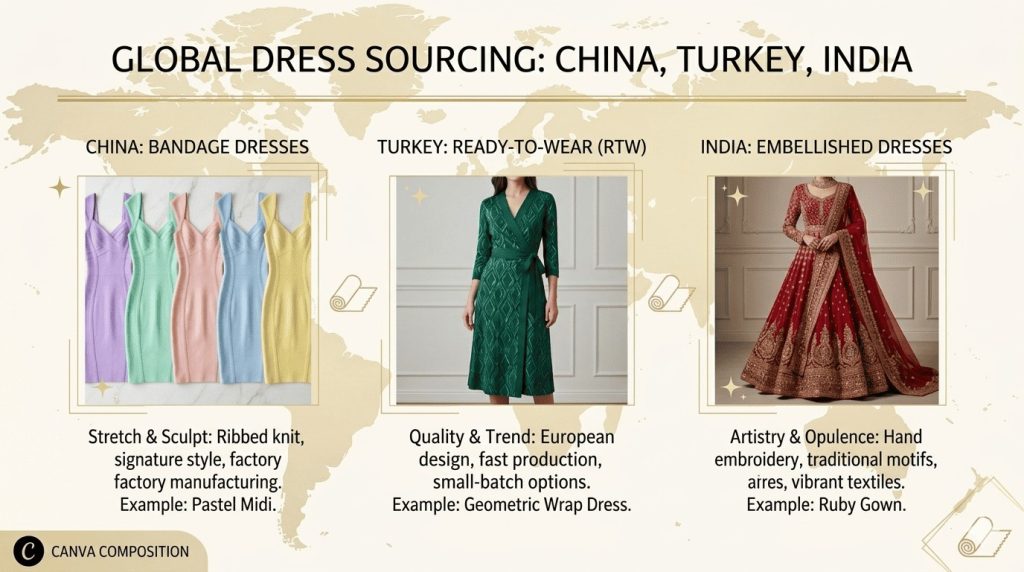
The 3 Countries at a Glance
Before we go deep, here is the macro picture. According to the World Trade Organization, the global apparel export market reached $557.5 billion in 2024, growing 7.08% year-over-year. Within that market, four countries — China, Vietnam, Turkey, and India — together account for 56.8% of all apparel exports, up from just 40% in 2010. The wholesale dress world has consolidated, and these three are the heart of it.
- China is the volume and variety powerhouse. $165.24 billion in apparel exports in 2024, roughly 29.6% of the global market.
- Turkey is Europe’s preferred neighbor. $19.7 billion in apparel exports in 2024, with 62% flowing into the European Union.
- India is the embellishment and ethnic-wear specialist. Around $15 billion in apparel exports, and growing 10.03% year-over-year in fiscal 2024-25.
Each one is the right answer for a different kind of buyer. Let’s break them down.
China: The Volume & Variety Powerhouse
China’s share of global apparel exports — 29.6% in 2024 — is actually the lowest it has been since 2010. That sounds like bad news for China, but the deeper story is more interesting: while finished garment production has spread to Vietnam, Bangladesh, and Cambodia, China’s share of global textile (fabric) exports has risen to 43.3%. In other words, even when a dress is sewn in Hanoi or Dhaka, the fabric was very likely woven in Guangdong or Zhejiang. China is still the spine of the global apparel supply chain.
For dress buyers specifically, this matters because dresses — especially trend-driven dresses, bandage dresses, sequin dresses, and party wear — depend on fabric innovation. New rayon blends, new bandage knits, new mesh and lace developments tend to appear in Chinese mills first.
Strengths:
- Widest style variety on earth — thousands of new designs released weekly across the Guangzhou wholesale ecosystem
- Strong fabric R&D and the fastest trend-to-market cycle in the world
- Lowest unit prices at scale ($8–$35 per dress for most categories)
- Mature export logistics: DHL, FedEx, UPS shipping in 5–8 days globally
- OEM and ODM capability is deeper than anywhere else
Weaknesses:
- Quality varies enormously between factories — the gap between the best and worst Chinese supplier is wider than the gap between countries
- Post-de-minimis, U.S. duty costs need to be modeled into your landed price
- Language and time-zone friction with first-time buyers (though the better factories have English-speaking sales teams)
Typical price range: $8–$35 per dress wholesale, depending on category MOQ reality: Officially 50–500 pieces at most factories. In practice, specialized wholesalers offer mixed-style MOQs as low as 6 pieces total across multiple styles — this is a meaningful niche worth knowing about. Lead time: 5–10 days for in-stock items; 25–45 days for OEM production Best for: Volume buyers, trend-driven boutiques, anyone needing wide style variety, and any buyer who values fabric quality

Turkey: The European Buyer’s Favorite
If you sell dresses in Europe — or you’re shipping into the UK — Turkey deserves serious consideration. The country has 65,000+ textile and apparel companies employing roughly 1.2 million people, and 62% of Turkish apparel exports flow into the European Union. Istanbul alone is responsible for 68.6% of Turkey’s ready-made garment exports, making it one of the densest fashion manufacturing clusters in the world.
The geography is the killer feature. A truck from Istanbul to Berlin takes a few days. A container from Shanghai to Hamburg takes weeks. For a European boutique that needs to react to trends in real time, Turkey can replenish bestsellers two or three times in the same window where China can deliver only once.
There’s also a regulatory advantage worth knowing: Turkey has a post-Brexit free trade agreement with the United Kingdom, which means UK buyers can import Turkish-made dresses duty-free.
Strengths:
- Fastest shipping to Europe of any major sourcing country
- Strong reputation for “European fit” — patterns cut for European body types
- Duty-free into the EU (Customs Union) and UK (FTA)
- Quality control is generally more consistent than China’s lower tier
- Strong in cotton-based dresses, denim dresses, and elevated casual wear
Weaknesses:
- More expensive than China at the same quality level (often 30–50% higher)
- Less variety — Turkey is strong in casual and elevated-casual; weaker in bandage dresses, sequin party wear, and trend-driven nightlife styles
- Lira volatility can complicate price negotiations
- Higher MOQs are more common (typically 100–300 pieces per style)
Typical price range: $12–$45 per dress wholesale MOQ reality: 100–300 pieces per style at most factories Lead time: 3–7 days to most European destinations; 20–35 days for production Best for: European retailers, UK buyers, brands focused on cotton and casual dresses, anyone selling to the “European fit” market
India: The Embellished & Ethnic Specialist
India is the most misunderstood of the three. Its $15 billion in annual apparel exports is the smallest of the trio, and its global market share is just 2.8%. But the headline numbers hide what makes India special: India retains 79% of its garment value domestically (only 21% external value content per OECD 2025 data), meaning it has the deepest vertical integration of any major exporter. From cotton field to finished dress, almost everything happens inside India’s borders.
This matters because India’s edge is craft. Hand embroidery, beadwork, mirror work, block printing, sequin embellishment done by skilled artisans — these are categories where India is the global leader and where China and Turkey simply cannot compete on cost or skill. If your store sells occasion dresses, wedding-guest dresses, festival wear, or anything that depends on intricate surface decoration, India should be on your list.
There’s another twist worth understanding: India exports less than half of what it produces, because its 1.43 billion-person domestic market consumes the rest. That means Indian factories are often more flexible than expected — they’re not desperate for export orders the way some smaller countries are, but they also have spare capacity for buyers who can communicate clearly.
Strengths:
- Unmatched craftsmanship in embroidery, beadwork, embellishment
- Vertically integrated supply chain (cotton, spinning, weaving, dyeing, sewing all domestic)
- Strong in sustainable cotton and natural fibers
- Lower labor costs than China or Turkey for comparable skilled work
- Growing fast: 10.03% year-over-year apparel export growth in fiscal 2024-25
Weaknesses:
- Slower lead times — production takes longer because so much of the value chain is in-house
- Less strong in synthetic, technical fabrics (the bandage knits and high-stretch fabrics common in nightlife dresses)
- Logistics from inland production hubs add days to door-to-door shipping
- Quality variance is real, especially for first-time buyers without an inspection partner
Typical price range: $10–$40 per dress; embellished pieces $25–$80 MOQ reality: 50–200 pieces per style is typical; embellished work often requires longer commitments Lead time: 35–60 days for production; 10–15 days shipping Best for: Boutiques specializing in occasion wear, festival dresses, embroidered and embellished styles, sustainable cotton dresses
Side-by-Side Comparison Table
| Factor | 🇨🇳 China | 🇹🇷 Turkey | 🇮🇳 India |
|---|---|---|---|
| 2024 Apparel Exports | $165.24B | $19.7B | ~$15B |
| Global Market Share | 29.6% | ~3.5% | 2.8% |
| Price Range (per dress) | $8–$35 | $12–$45 | $10–$40 |
| Typical MOQ | 6–500 pcs* | 100–300 pcs/style | 50–200 pcs/style |
| Production Lead Time | 25–45 days | 20–35 days | 35–60 days |
| Shipping Speed (global) | 5–8 days express | 3–7 days to EU | 10–15 days |
| Strongest Categories | Bandage, party, trend-driven, sequin, all variety | Cotton, denim, elevated casual, “European fit” | Embroidered, festival, occasion, ethnic, sustainable cotton |
| Best For | Global buyers, volume, variety | European/UK buyers | Occasion-wear specialists |
*The 6-piece minimum applies only to specialized wholesalers offering mixed-style assortments — most Chinese factories still require 50+ per style.
Which Country Should YOU Choose? — A Buyer’s Guide by Region
This is where most comparison guides stop. We’ll keep going, because the honest answer to “which country is best?” depends entirely on where you sell.
🇺🇸 For North American Buyers (US & Canada)
Primary recommendation: China.
Despite the end of the de minimis exemption, China remains the most logical primary source for most U.S. and Canadian dress retailers. The reason is simple: the variety, the fabric innovation, and the price-to-quality ratio at the right factory are still unmatched. The de minimis change means you should now consolidate orders into larger shipments (which most serious boutiques were already doing) rather than dropshipping individual parcels — but it does not change the underlying math of where dresses are best made.
That said, U.S. buyers should now budget more carefully for landed costs and look for Chinese suppliers with strong export documentation experience. The factories that handled commercial shipments (rather than de minimis parcels) all along are the ones who will be easiest to work with in 2026.
Secondary option: India, specifically for embellished and occasion-wear segments.
🇪🇺 For European Buyers (EU + UK)
Primary recommendation: Turkey, with China as a complement.
If you’re in Europe, Turkey is almost always the right starting point for casual and elevated-casual dresses. The combination of duty-free access, fast shipping, and European fit is hard to beat. Use Turkey for your core inventory and replenishment cycles.
Use China as a complement for the categories where Turkey is weak: bandage dresses, sequin party wear, trend-driven nightlife styles, and anything where you need exceptional variety. The longer shipping window from China is acceptable when you’re ordering categories Turkey can’t match anyway.
🇲🇽 For Latin American Buyers (Mexico, Colombia, Argentina, Chile)
Primary recommendation: China.
This is the section we want to spend time on, because Latin American buyers are an underserved segment in most sourcing guides — and the math here is decisive. There is no Turkey-equivalent close to Latin America. Indian shipping times are too long for fashion-forward boutiques. China, with its 6–8 day express shipping and unmatched style variety, fits Latin American retail patterns almost perfectly.
Consider how a typical Mexican boutique actually buys: a store owner in Monterrey might order 200–300 pieces per month, spread across 50–60 styles, just a few pieces per style, restocking weekly. That pattern — many styles, small quantities, frequent replenishment — is impossible at most Chinese factories with 100+ MOQs per style. It only works with specialized wholesalers offering mixed-style minimums (where you can order, say, 6 pieces total across any combination of styles). For Latin American buyers, finding a Chinese supplier with this kind of MOQ flexibility is the single most important sourcing decision you can make.
🇦🇺 For Australian & New Zealand Buyers
Primary recommendation: China.
Australia and New Zealand are in the same boat as Latin America — geographically closer to Asia than to Europe, and with no nearby manufacturing alternative. China’s 5–8 day express shipping reaches Sydney and Auckland just as quickly as it reaches Los Angeles. Australian seasonal calendars also benefit from China’s fast trend cycles, since Australian summer aligns with Northern Hemisphere “resort” collections that Chinese factories produce year-round.
Australian buyers should also consider India for boho, festival, and embellished pieces — the Indian aesthetic has a strong following in Australian boutique markets.
🇸🇦 For Middle Eastern Buyers (UAE, Saudi Arabia, Kuwait)
Primary recommendation: A blend of China and Turkey.
Middle Eastern buyers have unique needs — modest cuts, specific embellishment styles, longer-sleeved options, occasion-heavy wardrobes. Turkey serves the modest-fashion segment exceptionally well and ships into Dubai in days. China handles the volume and variety side. India is a strong third for embellished occasion wear.
Why Quality Control Matters More Than Country
Here is the uncomfortable truth that most comparison guides skip: the quality gap between two factories in the same country is almost always wider than the quality gap between countries. A top-tier Chinese factory will out-perform a mediocre Turkish one. A careless Indian workshop will disappoint you no matter how good Indian craftsmanship is in theory.
What actually determines whether your wholesale dress order arrives in good shape is not the country code on the invoice. It is the factory’s internal quality control process. Specifically:
- Pre-shipment size confirmation. Does the supplier confirm sizes with you before packing, or do they just ship whatever they pulled from the warehouse?
- Secondary inspection. Is there a second QC pass after the first one, or only a single check?
- Honest stock-out handling. When a size is out of stock, does the factory tell you honestly — or do they substitute a different size and hope you don’t notice? The “secret substitution” problem is one of the most common complaints from new buyers, and it happens in every country.
- Pattern and fit standards. Are the dresses being cut to consistent measurements, or does each production run drift?
Most factories — in any of the three countries — fail at one or more of these. The ones that get all four right are the ones worth building a long-term relationship with.
This is also where Winsome Fashion, our own factory in Guangzhou, focuses our 11 years of experience. We confirm sizes with every buyer before packing, we run secondary QC on every order, and we tell buyers immediately when a size is out of stock rather than substituting silently. This is not a unique philosophy — every serious factory should work this way — but it is unfortunately rare enough that it’s worth checking before you commit to any supplier in any country.
Real Buyer Case Studies
To make this concrete, here are two anonymized examples drawn from real wholesale relationships.
Case Study 1: An Online Dress Retailer in the U.S. Midwest
This retailer runs a primarily online boutique and orders 200–300 pieces per shipment, every 1–2 months. They typically buy 5–6 styles per order, with XS through XL coverage in each. Their price points are $15–$35 wholesale, and they mix bandage dresses with trend-driven fashion dresses to keep their assortment fresh.
For a buyer like this, China is the right primary source. The variety of bandage dresses simply doesn’t exist anywhere else, and the retailer has the order volume to absorb the new U.S. tariff structure without difficulty. Their key sourcing requirement is fabric quality consistency — bandage dresses live or die by how the fabric stretches and recovers, and a sub-par factory will sink the whole order.
Case Study 2: A Boutique Owner in Monterrey, Mexico
This buyer operates a brick-and-mortar dress store and buys differently from the U.S. retailer. She orders 200–300 pieces per month, but spread across 50–60 different styles, with just a few pieces per style. She restocks weekly, with some styles re-ordered monthly when they sell well. Her price points are $15–$27, mostly fashion dresses rather than bandage styles.
For her, mixed-style MOQs are non-negotiable. A factory requiring 100 pieces per style would be useless — she’d be forced to over-buy individual styles and tie up cash in inventory she can’t sell quickly. Her ideal supplier offers 6-piece minimum mixed-style ordering so she can combine 10 different styles into a single 60-piece order, restock the bestsellers next week, and rotate in new arrivals constantly. This is a sourcing pattern that fits perfectly with the low-MOQ wholesale dress model that is most useful for fast-rotating boutiques.
These two buyers shop in completely different ways, and yet both are best served by China — just by very different kinds of Chinese suppliers. This is why “which country?” is only half the question. “Which factory, with what MOQ structure, in that country?” is the other half.
Frequently Asked Questions
For most buyers globally, yes. China still produces 29.6% of the world’s apparel and offers the widest variety, fastest trend cycles, and best price-to-quality ratio at the right factory. The end of the U.S. $800 de minimis exemption changes the import math for American buyers, but it does not change the fundamental advantages of Chinese production. The key in 2026 is choosing factories that have always handled commercial shipments rather than relying on small-parcel loopholes.
Significantly. Since August 29, 2025, U.S. buyers can no longer import shipments under $800 duty-free, with full enforcement rolling out through July 1, 2027. The effect is that small drop-shipped parcels now face the same duty structure as commercial shipments, which has narrowed the cost advantage of certain low-volume sourcing models. The winners are buyers who consolidate into larger shipments, work with factories experienced in commercial export documentation, and choose suppliers who model landed cost transparently.
It depends entirely on the supplier type. Traditional Chinese garment factories typically require 100–500 pieces per style. Wholesale market vendors in Guangzhou often work with 30–50 pieces per style. A small number of specialized wholesalers offer mixed-style minimums as low as 6 pieces total, allowing buyers to combine multiple styles into one small order. This last category is the right fit for boutique owners who need style variety more than per-style depth.
For most European buyers, the right answer is “both, for different categories.” Turkey wins on cotton dresses, denim dresses, elevated casual wear, and anything that benefits from European fit and fast shipping into the EU and UK. China wins on bandage dresses, sequin party wear, trend-driven nightlife styles, and any category where variety and fabric innovation matter more than 5-day shipping. Most successful European boutiques use Turkey for core replenishment and China for fashion-forward additions.
Generally no — India’s strength is craftsmanship rather than trend speed. India is the global leader in embroidered, beaded, embellished, and ethnic-influenced dresses, and is increasingly strong in sustainable cotton. For these categories, India is unbeatable. For fast-fashion bandage dresses, sequin party wear, or trend-led styles where you need new designs every week, China remains the better choice.
Start with a sample order of 6–20 pieces across multiple styles. Inspect the fabric weight, stitching consistency, label finish, and most importantly the fit accuracy against the size chart. Ask the supplier directly how they handle stock-outs — a factory that admits “we tell buyers and offer alternatives” is more trustworthy than one that promises “we always have everything.” Request photos of your specific items before they ship, not generic catalog photos. And if possible, ask whether they conduct secondary QC after the initial inspection. These small questions reveal more about a supplier than any glossy company brochure.
Final Verdict
There is no single “best” country to buy wholesale dresses from — there is only the best country for your market, your category, and your buying pattern.
- If you sell in North America, Latin America, Australia, or anywhere globally and want maximum variety: Start with China. Find a factory that offers genuine quality control and mixed-style MOQs if your buying pattern requires it.
- If you sell primarily in Europe or the UK: Start with Turkey for your core, and add China for the categories Turkey can’t match.
- If you specialize in occasion wear, embroidered styles, festival dresses, or sustainable cotton: India should be your first call.
- If you sell across multiple categories: A two-country strategy almost always beats a single-country strategy. Buyers who use China + Turkey, or China + India, consistently report better margins and more resilient inventory than buyers who put everything in one basket.
Whatever country you choose, remember that the factory matters more than the flag. Spend more time vetting individual suppliers and less time worrying about the country-level statistics. The best Chinese factory will out-perform a mediocre Turkish one, and a great Indian workshop will deliver craftsmanship neither China nor Turkey can match.
If you’d like a starting point on the China side — including a real comparison of how different Chinese suppliers stack up — our previous guide, Best Wholesale Bandage Dress Suppliers in 2026, walks through 8 specific suppliers with honest pros and cons.
For broader industry context, the WTO’s Global Value Chains Sectoral Profile for Textiles and Clothing and Sheng Lu Fashion’s October 2025 trade analysis are the two most reliable public sources for the data cited throughout this article.
The dress wholesale world in 2026 is more global than ever — but also more rewarding for buyers who choose carefully. Pick your country with intention, vet your factory ruthlessly, and the rest tends to take care of itself.